Affiliate Disclosure:Kid Sitting Safe is reader-supported. When you buy through links on our site, we may earn an affiliate commission at no additional cost to you. This does not influence our reviews or recommendations — we only recommend products we genuinely believe in.
Most premium convertible comparisons turn on which seat holds a bigger child for longer. This one doesn’t, because the Nuna RAVA and the Britax Poplar S have effectively identical limits. Both take a newborn rear-facing from 5 pounds, both run rear-facing to 50 pounds, both go forward-facing to 65, and both stop harness use at 49 inches.
When the limits match, the spec sheet stops being the decision and the hardware starts being it.
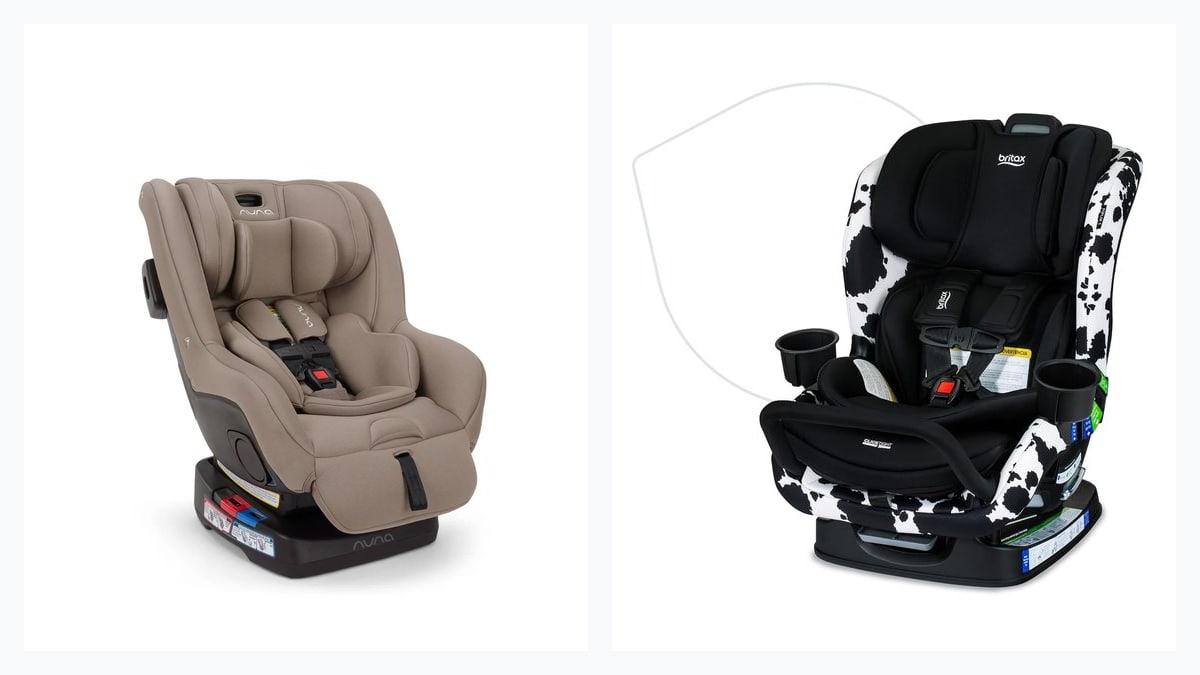
The short answer: for most families the Britax Poplar S is the better-engineered seat, and it costs less. Where the Nuna RAVA wins is comfort. Britax adds a rebound bar that Nuna doesn’t fit to the US RAVA, in a shell two inches narrower. Nuna answers with 10 recline positions against 6, and a nicer cover.
The verified spec comparison
| Specification | Nuna RAVA | Britax Poplar S |
|---|---|---|
| Rear-facing weight | 5-50 lbs | 5-50 lbs |
| Rear-facing height | 18-49 in | 18-49 in |
| Forward-facing weight | 30-65 lbs | 30-65 lbs |
| Forward-facing height | 34-49 in | 35-49 in |
| Seat weight | 27.9 lbs | 28.0 lbs |
| Shell width | 19 in | 17 in |
| Recline positions | 10 | 6 |
| Installation | True Tension doors | ClickTight |
| Rebound bar | Not listed (US model) | ReboundReduce stability bar |
| Frame | All-steel | Carbon steel |
| Side impact | SIP pods, EPO foam | SafeCell crumple zone |
| Fabric | Bamboo blend, FR-free | SafeWash, no added FR |
| Warranty | Not published | 1 year limited |
| Booster mode | None | None |
Specs verified against nunababy.com and us.britax.com on 31 July 2026. Both seats are certified to FMVSS 213, the federal standard for child restraint systems.
Which installs more securely?
Both seats solve the same problem, in different ways, and neither leaves you fighting a seat belt by hand.
Britax’s ClickTight is the more forgiving system. You open a panel on the seat, run the vehicle belt through a fully exposed and labelled belt path, buckle it, then close the panel. Closing it applies the tension mechanically, so a correct install doesn’t depend on your body weight or leverage. It’s the single strongest argument for buying a Britax.
Nuna’s answer is a pair of True Tension doors, one for the rear-facing belt path and one for forward-facing, sitting under the seat fabric with coloured belt path indicators. It works, and it’s a real tensioning mechanism rather than a marketing name for a standard belt path. It just asks slightly more of you than ClickTight does.
So this is a win for Britax on margin, not a rout. Anyone telling you the RAVA has no installation aid has misread the seat.
Which is safer?
Both meet FMVSS 213, and neither has a published crash-test rating that lets us rank them numerically. NHTSA’s ease-of-use ratings assess usability, not crash performance, and no independent body publishes comparative crash scores for these two seats. Anyone claiming one is “safer in a crash” is going beyond the evidence.
What we can compare is structure, and there the Britax has one feature the Nuna doesn’t: the ReboundReduce stability bar. Installed rear-facing, a rebound bar limits how far the seat rotates back towards the vehicle seat back in the second phase of a crash. Nuna doesn’t list a rebound bar or stability bar for the US RAVA. If you’re comparing across borders, note that the Canadian RAVA is a different specification that does require one rear-facing.
Beyond that the two take different routes to the same goal. Nuna uses side impact protection pods backed by EPO energy-absorbing foam over an all-steel frame. Britax uses its SafeCell crumple zone, a carbon steel frame and a V-shaped tether. Both are credible engineering, and the difference isn’t measurable from outside.
The honest verdict: structurally comparable, with the rebound bar as the one concrete advantage, and it belongs to Britax.
Which fits a real back seat?
The Poplar S, by two inches, and two inches is a lot.
Britax builds the Poplar S around a 17-inch shell and markets it for three-across installations, with the caveat that it can’t guarantee fitment in every vehicle. The RAVA is 19 inches wide. If you’re fitting three restraints across, running a narrow middle seat, or working in a compact car, that gap decides it before anything else does.
Front-to-back is closer than the width suggests. The RAVA is 16 inches deep and 25 tall; the Poplar S is 20.5 deep and 23.5 tall. Rear-facing depth matters for the front passenger’s legroom, so measure your own vehicle rather than trusting either number in isolation.
Weight is a non-issue. They’re within a tenth of a pound of each other, 27.9 against 28.0, so neither is the seat you move between cars casually.
Comfort and daily use
Here the RAVA earns its price.
Ten recline positions against six is the most useful difference. Recline range determines whether you can hit the correct angle for a newborn while working around a sloped vehicle seat, and it gives you room to adjust as a sleeping toddler’s needs change. Six positions is adequate; ten is genuinely more flexible.
The cover is the other one. Nuna describes its bamboo blend as breathable and moisture-wicking, and adds ventilated side panels. Britax’s SafeWash cover is machine washable and dryer-friendly, which is arguably more useful on a Tuesday morning.
One thing that is not a difference, despite both brands marketing it: flame retardants. Nuna’s bamboo blend is naturally flame resistant with no added chemicals, and Britax’s SafeWash fabrics also carry no added flame-retardant chemicals. Both clear that bar, so it can’t break the tie.
Britax publishes a 1-year limited warranty and a 10-year expiry. Nuna doesn’t publish a warranty period on its accessible US pages, so we’re not going to guess at one.
What does a 50 lb rear-facing limit actually buy you?
Both seats rear-face to 50 pounds, and that shared number is arguably the most valuable thing either one offers.
The AAP recommends children ride rear-facing as long as possible, up to the highest weight or height their seat allows. Rear-facing spreads crash forces across the whole back of the seat and supports the head and neck, which matters most while a child’s neck musculature and vertebrae are still developing.
A 50-pound rear-facing limit takes a typical child well past their fourth birthday, and height, not weight, is often what ends the rear-facing stage. Watch it on both seats. Once the top of the head is within an inch of the shell top rear-facing, or standing height passes 49 inches, the rear-facing stage is over regardless of what the scales say.
Neither seat wins here. Both give you the full extended rear-facing window, and if you’re comparing either against a seat that stops rear-facing at 40 pounds, that’s the more consequential decision than anything separating these two.
Living with them
The RAVA’s cover comes off for washing, but Britax’s SafeWash covers are machine washable and dryer-safe, which matters more than plushness the first time a car journey ends badly. The Poplar S also has two dishwasher-safe cup holders, and the RAVA doesn’t match that.
Harness adjustment is a wash. Both use a no-rethread system, so raising the harness means moving the headrest rather than dismantling and re-threading straps. Britax publishes 14 headrest positions with harness slot heights from 8 to 17 inches. Nuna publishes a no-rethread harness and a 2-position crotch strap but doesn’t publish a position count, so we can’t put a number against it.
Recline adjustment is where the RAVA’s 10 positions show up in daily use rather than on paper, particularly if you move the seat between vehicles with differently sloped back seats.
What about the standard Poplar, without the S?
Britax sells a plain Poplar alongside the Poplar S, and the difference is narrower than the naming suggests. Both carry identical limits: 5 to 50 pounds rear-facing, 30 to 65 forward-facing, 18 to 49 inches and 35 to 49 inches respectively. Both use ClickTight. Both share the same 20.5 by 17 by 23.5 inch shell, the same 14-position headrest and harness, the same 6-position recline, the same 1-year warranty and the same 10-year expiry.
Two things separate them. The S adds the ReboundReduce stability bar, and the plain Poplar is slightly lighter at 27.2 pounds against 28.0. The standard Poplar also sits a tier below on price.
So if the rebound bar is what drew you to the S, pay for the S. If you were buying it for the ClickTight install and the slim shell, the standard Poplar delivers both for less.
Longevity and what you’ll need next
Britax publishes a 10-year expiry from date of manufacture on both Poplar models, which is the useful figure when you’re weighing cost across siblings. Nuna doesn’t publish an expiry or a warranty period on its accessible US pages, so we’re leaving both blank rather than repeating a number from a retailer listing.
Neither seat has a booster mode. Both stop at 65 pounds with the harness, and at that point you’re buying a belt-positioning booster regardless of which you chose. Factor that into the comparison if you were weighing either against an all-in-one seat that carries through to booster mode, because the all-in-one changes the total number of seats you buy.
One more consideration for the rear-facing years: FMVSS 213a, the federal side impact test procedure, was issued in 2022 and is being phased in. Check the label and listing on the seat you buy for 213a certification. Certification wouldn’t rank the two against each other, but it tells you the seat has passed the side-impact test.
Measure before you commit
Neither seat is one you want to discover doesn’t fit after the box is open.
Shell width is the obvious number, 19 inches against 17, but it’s not the only one that decides a fit. Rear-facing, the seat’s depth and recline angle together determine how far it pushes into the front passenger’s legroom, and a steeper recline eats more space. The RAVA is 16 inches deep with a taller 25-inch shell; the Poplar S is 20.5 deep and 23.5 tall. Depending on your vehicle’s seat pan angle, either can end up needing more room than the other.
Three practical checks before buying:
- Measure the usable width of your back seat between the door trim and any adjacent restraint, not the width quoted in the vehicle brochure
- Rear-facing, check the front seat can still go far enough back for whoever sits there daily
- Confirm your vehicle’s belt path is accessible, because ClickTight needs the panel to open fully and True Tension doors need clearance under the fabric
Britax is explicit that it can’t guarantee three-across fitment in every vehicle even with the 17-inch shell, which is a fair caveat rather than a get-out. Vehicle back seats vary too much for any manufacturer to promise otherwise.
If you’re within an inch either way, a local child passenger safety technician can check fitment in your actual car before you buy. It’s free in most areas and it beats guessing.
Which should you buy?
Buy the Britax Poplar S if you’re fitting three across or driving something compact, you want the most forgiving installation system on the market, or you want a rebound bar for the rear-facing years. It’s the better value, and for most families it’s simply the better seat.
Buy the Nuna RAVA if recline flexibility matters, your child runs hot and the bamboo cover and ventilated panels will get used, or you want the nicer object and the width isn’t a constraint in your vehicle.
What shouldn’t drive the decision either way: crash limits, since they’re identical; flame-retardant-free fabric, since both have it; and seat weight, since they’re a tenth of a pound apart.
Whichever you choose, remember that neither converts to a booster. Both stop at 65 pounds with the harness, and you’ll need a separate belt-positioning booster after that. Our guide to highback boosters versus harnessed seats covers what that transition actually involves.
Further reading
- Nuna RAVA review
- Nuna RAVA vs Clek Foonf
- Convertible vs all-in-one car seats
- Highback booster vs harnessed car seat
Head-to-Head Comparison
Detailed Reviews
Nuna RAVA
Best premium comfortTen recline positions and a bamboo blend cover, in a wider shell.
What We Like
- Bamboo blend fabric is breathable, moisture-wicking and free of added flame retardants
- Ventilated side panels for enhanced airflow and comfort
- No-rethread harness simplifies height adjustments
- Side impact protection pods with EPO energy-absorbing foam
- Extended rear-facing capability up to 50 pounds
What We Don't
- Highest price point in convertible car seat category
- Heavy at 27.9 pounds, making transfers difficult
- Wide base may not fit well in smaller vehicles
Britax Poplar S
Best for tight vehiclesClickTight install and a rebound bar in a 17-inch shell.
What We Like
- ClickTight installation removes most of the guesswork from a tight fit
- Slim 17-inch shell is designed to fit three across
- Extended rear-facing to 50 lbs, matching the premium tier
- ReboundReduce stability bar limits rear-facing rebound movement
- 14-position no-rethread headrest and harness adjust together
What We Don't
- Only 6 recline positions against 10 on the Nuna RAVA
- 1-year limited warranty is short for the price
- At 28 lbs it is no lighter than seats without the slim shell
- Cover is washable but lacks the natural-fibre options of premium rivals
Britax Poplar Magenta Onyx
Best budget alternativeSame limits and same ClickTight install, without the rebound bar.
What We Like
- Vibrant magenta onyx color with premium fabric
- ClickTight installation for easy, secure fit
- Slim 17-inch design fits 3-across in most vehicles
- 2-in-1 convertible design (rear-facing 5-50 lbs, forward-facing 30-65 lbs)
- Steel frame and impact-absorbing base
What We Don't
- Premium pricing compared to infant-only seats
- Heavier than infant carrier seats (not portable)
- Convertible design means no travel system carrier option
Sources & Research
- Nuna Official Product Page
- Nuna RAVA user manual, US, 2024 and newer, linked from Nuna's product page
- Britax Official Product Page
- Amazon Product Page
- Britax Poplar S user guide (P15154600_A.1, 05.25), linked from the product page
- Amazon Product Page
- Britax Official Page
- Britax Poplar User Guide (P15154500, models starting E1D22, E1D42)
Continue Reading
Explore more car seat comparisons content or browse our other categories.
Frequently Asked Questions
- Do the Nuna RAVA and Britax Poplar S fit the same size children?
- Yes, almost exactly. Both allow rear-facing from 5 to 50 pounds and forward-facing from 30 to 65 pounds, and both cap harness use at 49 inches. The only published difference is the forward-facing minimum height, 34 inches on the RAVA against 35 inches on the Poplar S. Neither seat converts to a booster, so both need replacing once your child passes 65 pounds.
- Which one is easier to install correctly?
- Both use a built-in belt tensioning system rather than relying on you to pull the slack out by hand. Britax uses ClickTight, where you open the seat, thread and buckle the vehicle belt, then close the panel to tension it. Nuna uses True Tension doors, one for rear-facing and one for forward-facing, under the seat fabric. ClickTight is the more forgiving of the two, but neither seat leaves you tensioning a belt unaided.
- Does the Nuna RAVA have an anti-rebound bar?
- Not on the US model. Nuna doesn't list a rebound bar or stability bar on its US RAVA product page. The Britax Poplar S does include a ReboundReduce stability bar, which limits how far the seat rotates back towards the vehicle seat in a crash when installed rear-facing. Note that the Canadian RAVA is a different specification and does use a rebound bar.
- Which seat is better for three across?
- The Britax Poplar S. Its shell is 17 inches wide against the RAVA's 19 inches, and Britax designs and markets it specifically for three-across installations, though it doesn't guarantee fitment in every vehicle. Two inches is a large margin in a back seat, so if you're fitting three restraints or working around a narrow middle position, the Poplar S is the practical pick.
- Does the Nuna RAVA justify the extra money?
- It depends on what you're buying. The RAVA gives you 10 recline positions against 6, a bamboo blend cover, and ventilated side panels. It doesn't give you better crash limits, because the limits are identical, and it doesn't give you a rebound bar. If comfort and recline flexibility matter most, the premium is defensible. If installation security and fitting a tight vehicle matter most, the Britax is the better seat for less.
- Are both seats free of added flame retardants?
- Yes. Nuna markets the RAVA as FR-free, using a naturally flame-resistant bamboo blend with no added fire-retardant chemicals. Britax uses SafeWash fabrics with no added flame-retardant chemicals. It's a genuine feature on both, so it shouldn't decide the comparison.
Written By
Kid Sitting Safe
Our team researches car seat safety standards, crash test data, and real-world usability to help parents make the safest choice.
Related Articles
Chicco KeyFit vs Graco SnugRide: Which Infant Car Seat Is Best?
We compare the Chicco KeyFit and Graco SnugRide infant car seats side by side. Find out which is best for your budget, vehicle, and lifestyle.

Evenflo Embrace LX Review: Budget-Friendly Infant Car Seat
Review of the Evenflo Embrace LX infant car seat, a model Evenflo has retired. Safety features, installation, comfort, and what it means for families still using one.
Nuna vs UPPAbaby: Luxury Infant Car Seat Comparison
Compare Nuna PIPA vs UPPAbaby Mesa infant car seats on luxury features, safety, stroller compatibility, and value to help you choose the best premium infant seat.