Affiliate Disclosure:Kid Sitting Safe is reader-supported. When you buy through links on our site, we may earn an affiliate commission at no additional cost to you. This does not influence our reviews or recommendations — we only recommend products we genuinely believe in.
Parents usually reach this question because a child has hit some milestone, an age, a weight, a birthday, and a booster suddenly looks like the next step. The milestone is rarely the right trigger.
A harnessed car seat is safer than a highback booster for any child who still fits the harness. The reason isn’t padding or price. It’s that the two devices do fundamentally different jobs. A harness restrains your child. A booster restrains nothing at all; it repositions the adult seat belt so the belt can do the restraining.
Getting that distinction clear makes almost every other decision here obvious.
Is a harnessed car seat safer than a highback booster?
Yes, provided the child still fits within the harness limits. NHTSA’s guidance is to keep a child in a forward-facing car seat with a harness and tether until they reach the top height or weight limit allowed by the manufacturer. The American Academy of Pediatrics phrases it as using a forward-facing seat with a harness “for as long as possible, up to the highest weight or height allowed by your car safety seat manufacturer.”
Neither organisation frames the booster as an upgrade. It’s the next step down in restraint type, taken when the child has grown out of the better option.
That’s the whole verdict. The rest of this page explains why the difference is real rather than a matter of degree, because understanding the mechanism is what stops parents switching early.
What actually differs between a harness and a booster?
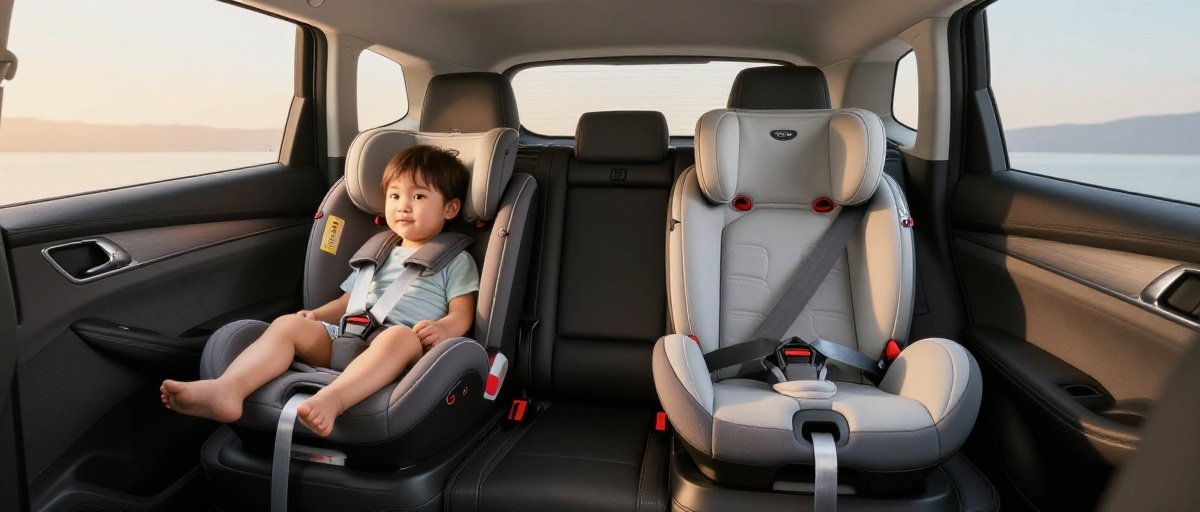
A five-point harness holds the child against the seat at five contact points: both shoulders, both hips, and the crotch strap between the legs. Those points sit over the shoulder girdle and the pelvis, the parts of a child’s skeleton best able to take load. In a crash, the harness begins restraining the child immediately, and it spreads the force over a wide area of webbing.
A highback booster does none of that. It lifts the child so that the vehicle’s own lap and shoulder belt lands in the right place, with the lap portion low across the upper thighs rather than the soft abdomen, and the shoulder portion across the collarbone and centre of the chest rather than the neck. A belt guide on the shoulder holds that routing. The child is then restrained by a belt designed around adult body proportions, at two contact points instead of five.
Both approaches are legitimate, and both are tested. What separates them is how much of the outcome depends on the child.
What does a harness do that a booster can’t?
A harness works regardless of how your child is sitting.
Booster protection assumes correct posture for the entire journey. If a child slouches down, the lap belt rides up onto the abdomen, where there’s no skeletal structure to take crash load. If they tuck the shoulder belt under an arm or behind their back, because it’s rubbing their neck or they want to lean over, the upper body is left unrestrained. If they fall asleep and slump sideways, the belt no longer sits where it was positioned.
None of those failure modes apply to a harness. A harnessed child who falls asleep is still restrained at five points. A harnessed child who wriggles is still restrained at five points.
So the practical difference isn’t only the crash physics. It’s that a harness removes your child’s minute-to-minute behaviour from the safety equation, and a booster puts it right at the centre. That’s why maturity, not just size, is part of every credible booster readiness test.
What do FMVSS 213, NHTSA and the AAP say?
FMVSS 213 is the federal standard covering child restraint systems in the United States, and it covers both harnessed seats and boosters. A booster passing FMVSS 213 is genuinely a certified child restraint, not an unregulated accessory. Since 2022 the associated side impact standard, FMVSS 213a, has added a side impact test procedure. Certification tells you a seat meets the federal bar, but it doesn’t tell you a booster equals a harness, because the two are evaluated as different device types.
NHTSA directs parents to keep the child in the harness to the manufacturer’s top limit, then move to a booster, then stay in the booster until the adult belt fits properly on its own. For the belt to fit, NHTSA specifies the lap belt lying snugly across the upper thighs rather than the stomach, and the shoulder belt lying snugly across the shoulder and chest without crossing the neck or face.
The AAP recommends the harness “as long as possible, at least to 4 years of age”, and lists three signs the forward-facing seat has been outgrown: reaching the manufacturer’s top harness weight or height, shoulders above the top harness slots, or the tops of the ears level with the top of the seat.
All three point the same way. Delay the switch, then make it properly.
When does a highback booster become the right choice?
Once your child has genuinely outgrown the harness. At that point a booster isn’t a compromise, it’s the correct restraint, and continuing to force a child into a harness that no longer fits is its own hazard.
Outgrown means any one of these:
- Their weight or standing height exceeds what the manufacturer permits for harness use
- Their shoulders sit above the top harness slot position
- The tops of their ears have reached the top of the seat shell
Check your specific seat’s manual for the numbers, because harness limits vary a lot. NHTSA’s own figures show that of 107 forward-facing harnessed models on the market, 85.9% allow harness use to 65 pounds, 10.2% stop at 40 pounds and 3.7% stop at 50. A seat that quits at 40 pounds will need replacing years before one that runs to 65.
Our guide on when kids can sit in a booster seat covers the readiness assessment in detail, including the maturity side.
Don’t read this as “boosters are unsafe”
To say it plainly, because the comparison above can be misread: a booster is a large safety gain over what usually replaces it, which is the seat belt on its own.
CDC research puts it at a 45% reduction in the risk of serious injury for children aged 4 to 8 using a booster, compared with using the vehicle seat belt alone.
So there are two distinct mistakes here, and only one of them gets talked about:
- Switching to a booster too early, while the child still fits a harness. Costs you the harness advantage described above.
- Skipping or abandoning the booster too early, moving straight to the adult belt. Costs you far more, and it’s the more common error once children start objecting to looking babyish in front of friends.
The second mistake is the bigger risk to your child. A child in a booster who should still be harnessed is less well protected than they could be. A child in a seat belt alone who should be in a booster is riding with a belt crossing their abdomen and neck.
Where each one usually goes wrong
Harness seats fail through installation and adjustment. Common problems are a harness left too loose, retainer clip sitting at belly height rather than armpit level, and bulky coats trapped underneath the straps. Our guide to how tight car seat straps should be covers the pinch test.
Boosters fail through belt routing and the child’s posture. Watch for the shoulder belt tucked behind the back or under the arm, the lap belt riding up over the stomach, the child unclipping themselves on longer journeys, and a backless booster used in a seating position with no head restraint behind it.
The pattern is consistent with everything above. Getting a harness right is a job you do once per install. Getting a booster right is a job that continues for as long as your child rides in it.
Highback or backless, once you’ve switched?
A highback booster is the better starting point. It adds a shoulder belt guide that keeps the belt routed correctly, head and torso support for sleeping children, and structure around the head. A backless booster positions the lap belt and little else, so it depends on the vehicle having a head restraint at the right height.
We’ve compared the two in depth in highback vs backless boosters. The short version is that highback first, backless later, is the sensible order.
Buying a harness seat that lasts
If you accept the argument above, the practical consequence is that harness capacity is what to pay for, because it’s what determines how long you can delay the switch.
NHTSA’s figures on the 107 forward-facing harnessed models it surveyed are the useful guide: 85.9% run the harness to 65 pounds, 10.2% stop at 40, and 3.7% stop at 50. A 40-pound harness limit sounds adequate until you notice that many children reach 40 pounds around age 5, which is exactly when the AAP would still have them harnessed.
Height usually runs out before weight. Watch the top harness slot position against your child’s shoulders, and the top of the shell against the tops of their ears, because either one ends the harness stage regardless of the number on the scales.
Two questions to ask before you buy:
- What’s the harness weight limit, and is it 65 pounds or 40?
- How tall is the top harness slot, and how does that compare with your child’s seated shoulder height now?
A seat that harnesses to 65 pounds with tall top slots can be the difference between switching to a booster at 5 and switching at 7.
What about state law?
State law sets a floor, not a recommendation. Booster requirements vary widely, and in many states a child becomes legally allowed to use an adult seat belt years before the belt will actually fit them properly.
Legal compliance and best practice aren’t the same question. NHTSA’s fit criteria, the lap belt low across the upper thighs and the shoulder belt across the shoulder and chest without touching the neck or face, are the standard to use, because they describe whether the restraint works rather than whether you’d pass a roadside check. Most children don’t meet them until somewhere around 4 feet 9 inches tall, which the AAP puts at roughly 8 to 12 years old.
Harness-to-booster seats let you avoid the choice
Combination seats run a five-point harness through the harness years, then the harness comes out and the same shell serves as a highback booster. Buying one means the switch happens when your child outgrows the harness, rather than when your budget says it’s time for another seat.
That matters, because a common reason parents move to a booster early isn’t a considered safety judgement. It’s that the harness seat looks small, or a sibling needs it, or a booster is cheaper and easier to move between cars.
The verdict
Keep your child in the harness until they’ve outgrown it by the manufacturer’s numbers, then move to a highback booster, then to backless, then to the belt alone. Each step trades restraint for freedom, and there’s no prize for reaching the next one early.
If you take one idea away, make it this: a five-point harness restrains at five points over strong bone, and it does so whether your child is sitting up straight or fast asleep. A booster asks your child to hold up their end of the deal for the whole trip.
And if you’re already past the harness stage, don’t let the comparison push you the wrong way. Between a booster and no booster, the booster wins by a wide margin. The argument here is about switching at the right time, not about treating boosters as a compromise you should hurry through.
Further reading
- When can kids sit in a booster seat?
- Highback vs backless boosters
- Booster seat reviews
- How tight should car seat straps be?
Head-to-Head Comparison
Detailed Reviews
Britax Grow With You ClickTight
Best harness-to-boosterRuns the harness to 65 lbs, then converts to a highback booster.
What We Like
- ClickTight installation system for secure, error-free installation
- Converts from harness to booster for extended use (30-120 lbs)
- 2-layer side impact protection with energy-absorbing foam
- Easy harness adjustment without rethreading
What We Don't
- Premium pricing for a harness-to-booster seat
- Forward-facing only, so not for infants or for toddlers under 30 lbs
- Heavier than some competitors, reducing portability
Chicco MyFit Harness+Booster
Best comfort alternativeStrong competitor with excellent comfort and safety features.
What We Like
- 4-position recline for comfort on long trips
- DuoGuard side impact protection system
- Premium fabrics and padding for comfort
- Easy harness adjustment with no-rethread system
What We Don't
- 25-100 lb range is narrower than some competitors (Britax 49-120 lbs)
- Heavier seat (25 lbs) makes vehicle transfers difficult
- Installation more complex than ClickTight systems
Chicco KidFit
Best pure highback boosterPremium booster with superior adjustability and comfort.
What We Like
- 10-position headrest for growing children
- SuperCinch LATCH tightener for added stability
- Ergonomic seat design for comfort on long trips
- Removable washable fabrics for easy cleaning
What We Don't
- Higher price than basic belt-positioning boosters
- Takes up more vehicle space than backless boosters
- Larger footprint than backless-only boosters
Graco TurboBooster LX Backless Booster
Best budget backless boosterA sound, cheap backless booster for a child who is already 40 lb and 43 inches, in a car with a decent headrest. If you want head and side support, or your child is at the bottom of the booster range, buy a highback instead.
What We Like
- Light and easy to move between cars, which is most of the point of a backless booster
- Adjustable armrests for comfort
- Dual integrated cup holders
- LATCH connectors, so it stays put when nobody is sitting in it
What We Don't
- Backless only: no head or side support, so the vehicle needs its own headrest behind the child
- No side impact protection, unlike a highback booster with energy-absorbing foam in the wings
- Less padding than premium options like Chicco KidFit
Sources & Research
- Amazon Product Page
- Britax Official Page
- Britax Grow With You ClickTight / ClickTight PLUS User Guide (P14368600, 2022)
- Amazon Product Page
- Chicco Official Product Page
- Chicco MyFit Harness + Booster product page (current model, 00087211720070)
- Chicco MyFit (2025+) instruction manual (IS0244E_04)
- Chicco MyFit product page, earlier 79783 model (Wayback Machine, October 2021)
- Chicco MyFit instruction manual for the earlier 79783 model (IS0154E_08, 01/20), still hosted by Chicco
- Chicco Official Product Page
- Chicco KidFit Plus booster manual (2022), linked from the product page
- Amazon Product Page
- Graco TurboBooster 2.0 Highback (model 2184597), read 2026-08-04. Source for the line's real limits, 40-100 lb / 43-57 in / at least 4 years old, in BOTH modes. The previously cited turbobooster-lx-highback URL 404s
- Graco TurboBooster LX Backless Booster with LATCH (model 2156222), found by searching gracobaby.com for the model number
Continue Reading
Explore more car seat safety content or browse our other categories.
Frequently Asked Questions
- Is a highback booster safer than a harnessed car seat?
- No. For a child who still fits within the harness limits, a harnessed car seat gives better crash protection. A five-point harness restrains the child's body directly at the shoulders and hips, while a highback booster only raises and routes the adult seat belt. Both the American Academy of Pediatrics and NHTSA advise keeping a child in the harness until they reach the top height or weight the manufacturer allows.
- At what point does a booster become the safer option?
- A booster becomes correct once the child has genuinely outgrown the harness, which happens when they exceed the manufacturer's harness weight or height limit, when their shoulders sit above the top harness slots, or when the tops of their ears reach the top of the seat shell. A harness that no longer fits isn't safer than a well-fitted booster, it's worse.
- Why does a five-point harness protect better than a seat belt?
- A five-point harness spreads crash forces across five contact points on the shoulders, hips and between the legs, all of which sit over strong skeletal structure. It also holds the torso in position, so the child stays properly restrained whether they're awake, asleep or slumped. A vehicle lap and shoulder belt was engineered for adult proportions and gives two contact points.
- Does a highback booster offer more protection than a backless booster?
- A highback booster adds head and torso support, a shoulder belt guide that holds the belt in position, and side structure around the head. It's the better choice for vehicles without head restraints and for children who fall asleep in the car. Both types position the belt, so neither restrains the child the way a harness does.
- My child meets the minimum age and weight for a booster. Should I switch?
- Not by itself. Booster minimums, commonly 4 years old and 40 pounds, describe the earliest point a booster may be used, not the point at which switching is advised. If your child still fits the harness, staying in it is the safer call. The AAP puts it as keeping children in a harness as long as possible.
- Can one seat do both harness and booster?
- Yes. Combination or harness-to-booster seats run a five-point harness for the earlier years, then the harness comes out and the same shell works as a highback booster. It lets you delay the switch until your child has actually outgrown the harness rather than until you need to buy a new seat.
Written By
Kid Sitting Safe
Our team researches car seat safety standards, crash test data, and real-world usability to help parents make the safest choice.
Related Articles
Benefits of a Load Leg Car Seat: Enhanced Safety Explained
Consumer Reports found about 46% lower average head-injury risk in infant seats with a load leg. How load legs work, which car seats have them, and where they don't fit.

Car Seat Laws by State: How to Find Yours, and Why the Lists Are Wrong
How to find your state's car seat law and read it properly, why the state-by-state lists in circulation are unreliable, and the three states wrongly listed as requiring rear-facing until age 2.
Car Seat After Accident: When to Replace & Insurance Coverage
Learn when car seats must be replaced after accidents. NHTSA guidelines, insurance coverage options, and how to assess if your seat is still safe to use.