Affiliate Disclosure:Kid Sitting Safe is reader-supported. When you buy through links on our site, we may earn an affiliate commission at no additional cost to you. This does not influence our reviews or recommendations — we only recommend products we genuinely believe in.
Air travel with children presents unique challenges for safety-conscious parents. While children under 2 can legally travel as “lap infants,” the FAA and safety experts strongly recommend securing children in FAA-approved car seats during all phases of flight.
Here’s what we’ll cover: FAA approval requirements, installation procedures, airline policies, and the best travel-friendly car seats available in 2026.
Quick Comparison: Best Travel Car Seats
| Car Seat | Rating | Type | Value | Weight | Best For |
|---|---|---|---|---|---|
| WAYB Pico | 4.3/5 | Forward-facing | Premium | 8 lbs | Frequent flyers |
| Safety 1st Grow and Go | 4.3/5 | Convertible | Budget | 17.2 lbs | Budget travel |
| Britax Poplar | 4.5/5 | Convertible | Mid-Range | 27.2 lbs | Full protection, 17” |
| BubbleBum | 4.0/5 | Booster | Budget | 1 lb | Booster age kids |
Ratings are our editorial assessment, weighing published specs, manufacturer documentation and independent reviewer consensus. We don’t test products ourselves.
Why Use a Car Seat on an Airplane?
Turbulence Protection
During unexpected severe turbulence, a lap child can be thrown from an adult’s arms. A properly installed car seat keeps your child secure during these unpredictable events.
Takeoff and Landing Protection
The most dangerous phases of flight are takeoff and landing. Car seats provide crash protection during aborted takeoffs, hard landings, and runway incidents - events where lap-held children face severe injury risks.
Peace of Mind
Travel is stressful enough without worrying about your child’s safety. A familiar car seat provides consistency and security in an unfamiliar environment.
FAA Regulations and Requirements
Here’s how the regulatory landscape breaks down. The FAA allows children under 2 to travel as lap infants, but strongly recommends car seats for optimal protection. Any seat used on board must bear the FAA approval label confirming aircraft certification. The AAP says the FAA and AAP both recommend that children under 40 pounds be secured in certified child restraints when flying. One thing that catches parents off guard: children over 2 need their own ticketed seat, but nothing requires them to use a car seat in it.
FAA Approval: What You Need to Know
The Approval Label
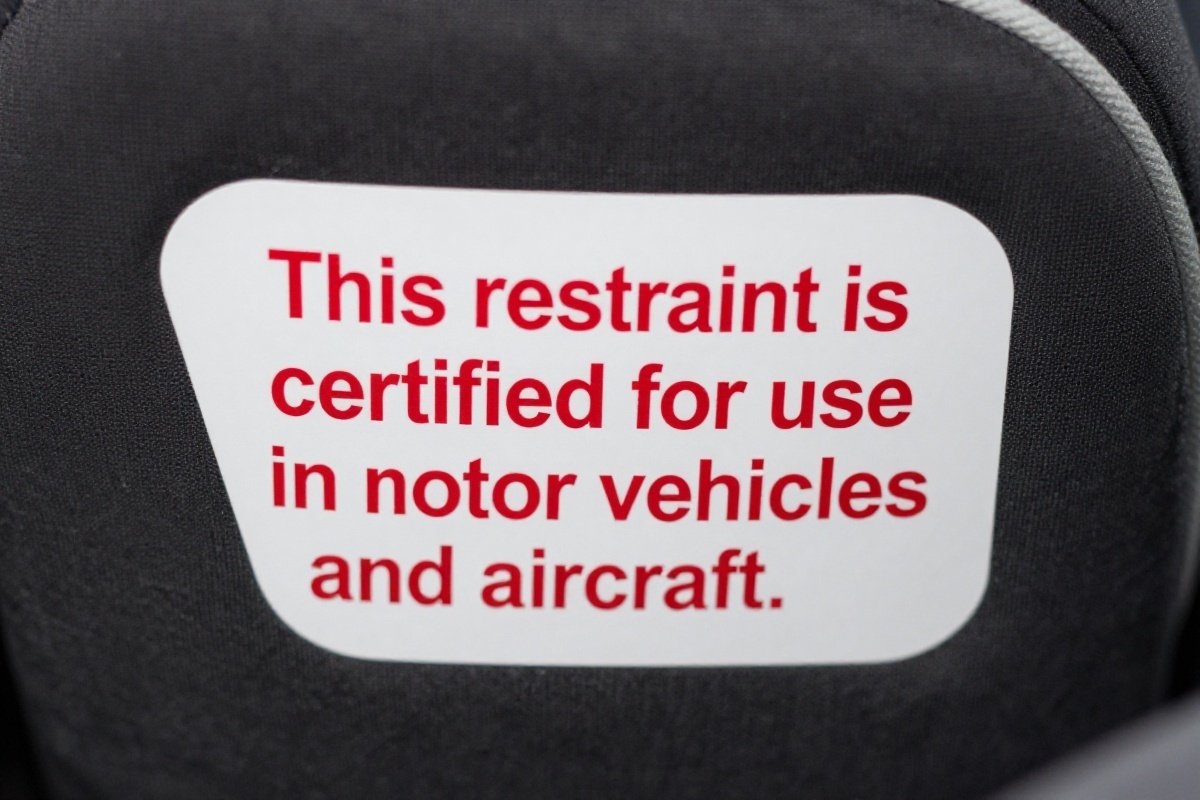
Every car seat approved for aircraft use carries a specific label stating:
“This restraint is certified for use in motor vehicles and aircraft.”
This label is typically found on the side or back of the seat, near the manufacturing date.
Which Seats Are Approved?
Approved:
- Most convertible car seats
- Most forward-facing seats with harness
- Travel-specific car seats (WAYB Pico, etc.)
NOT Approved:
- Booster seats (require shoulder belts airplanes don’t have)
- Vest-style restraints like the RideSafer Travel Vest (unless specifically aircraft-approved)
- Car beds (special medical devices only)
Booster Seats on Airplanes
Booster seats cannot be used on aircraft because they require lap-and-shoulder belts. Airplane seats only have lap belts. Children who normally use booster seats should either:
- Use an FAA-approved 5-point harness seat on the plane
- Use the airplane lap belt properly adjusted
- Use a CARES harness (Child Aviation Restraint System)
Airline-Specific Policies
FAA regulations set the baseline, but individual airlines can add their own policies on top. Most domestic carriers allow FAA-approved car seats in any purchased seat, though some restrict usage to window seats. Budget carriers may have more restrictive policies regarding dimensions and placement. Some international airlines won’t recognise certain foreign-approved seats at all. Always contact your specific airline before travel to confirm their current policies; don’t assume what worked on one airline will fly (literally) with another.
Best Travel Car Seats for 2026
WAYB Pico: Best for Frequent Flyers
The WAYB Pico was designed specifically for travel. At just 8 pounds and folding to the size of a briefcase, it redefines portability. Key Features:
- AstroKnit fabric: Breathable and comfortable for long flights
- Lightweight aluminum frame: Strong yet portable
- FAA-approved: Full approval for aircraft use
- Compact fold: Fits in overhead bins
Limitations:
- Forward-facing only (minimum 22 pounds)
- Limited recline for sleeping
- Premium price point
Safety 1st Grow and Go: Best Budget Option
The Safety 1st Grow and Go offers budget-friendly versatility as a 3-in-1 convertible seat that transitions from rear-facing through booster mode. Key Features:
- 3-in-1 design: Rear-facing, forward-facing, and booster modes
- Extended use: 5 to 100 pounds across all modes
- FAA-approved: Full aircraft certification
- QuickFit harness: Easy one-hand adjustment
Britax Poplar: Best Full Protection
Britax retired the Marathon ClickTight along with the rest of the ClickTight convertible line, so the current equivalent is the Poplar. It keeps the ClickTight belt-tensioning system and, at a 17-inch shell and 27.2 lbs, it is narrower than the Marathon it replaces, which matters on a narrow aircraft seat.
Key Features:
- ClickTight installation: the same open, thread, close routine as in the car - see our Britax vs Chicco comparison
- Slim 17-inch shell: less likely to foul the armrests
- 10-year expiry: usable for years after the trip
Check the label before you fly. Britax does not publish aircraft certification on the Poplar product page, so don’t take it on trust from us or anyone else. Any seat approved for aircraft carries a red label reading “This restraint is certified for use in motor vehicles and aircraft”. If your seat doesn’t have that text, cabin crew can refuse it at the gate.
Trade-off: at 27.2 pounds it is still heavy to carry through an airport.
Installation on Aircraft
Step-by-Step Installation
- Raise the airplane seat armrest (if movable)
- Position the car seat rear-facing or forward-facing as appropriate
- Route the lap belt through the car seat’s belt path
- Buckle and tighten until the seat moves less than 1 inch
- Test the installation by pushing and pulling at the belt path
Differences from Vehicle Installation
- No LATCH system: Aircraft don’t have lower anchors
- Lap belts only: No shoulder belts to work with
- Narrower seats: Some car seats may not fit
- Different seat angles: May affect recline positions
Troubleshooting
Seat is too loose:
- Ask a flight attendant for a seat belt extender
- Try a different aircraft seat
- Consider your car seat may be too wide
Seat doesn’t fit:
- Some aircraft seats are narrower than 16 inches
- Bulkhead seats often have fixed armrests
- Try moving to a different row
Gate-Checking Safety
Gate-checking your car seat? A few steps protect it from damage. Use a protective travel bag designed for car seats; rough handling is the norm, not the exception. Remove any loose attachments or accessories before checking. Label the seat clearly with your name and contact information.
On getting the seat as far as the gate: the Go-Go Babyz Travelmate, the wheeled cart most often recommended for this, has been discontinued, so a padded car seat bag with backpack straps or a folding luggage trolley is what’s left. Whatever you use, it needs to come off easily at the aircraft door.
When you get it back, inspect it carefully. Cracks, stress marks, or damaged padding mean you shouldn’t use the seat. Any damage could compromise safety, and you won’t always be able to see internal issues. If something looks off, don’t risk it.
Gate-Checking vs. Checking at Counter
Gate-Checking Advantages
- Reduced handling (less damage risk)
- Access to seat until boarding
- Typically loaded last/unloaded first
- More careful treatment by ground crew
Counter-Checking Advantages
- Don’t carry through airport
- Can use stroller/cart until check-in
- Less to manage at security
Damage Risks
Checked car seats face significant damage risks:
- Rough baggage handling
- Compression damage in cargo holds
- Exposure to weather/extreme temperatures
- Loss or misrouting
Recommendation: If you must check a car seat, use a protective bag and consider it “damaged until proven otherwise.” Inspect thoroughly before use.
International Travel Considerations
International travel adds a layer of complexity. Your FAA-approved seat will be recognised by most international carriers, but “most” isn’t “all.” Some foreign airlines won’t accept non-local-approved seats, and European carriers often have stricter policies regarding dimensions and placement than US domestic flights.
Research your destination country’s car seat laws for ground transportation; some nations require children to use locally approved seats in vehicles, which could catch you out. Bring documentation proving your seat’s approval status. And don’t assume the rules are the same in both directions; the airline you fly out on may have different policies than the one bringing you home.
Further Reading
- Uber with Car Seat: Rideshare Safety Guide for Parents
- Travelling with Kids: Practical Tips for Stress-Free Family Trips
- Car Seat Safety Guide: AAP Guidelines & Essential Tips for Parents
Alternative Restraint Options
CARES Harness
For children 22-44 pounds, the CARES harness is an FAA-approved alternative to bringing a car seat:
- Weighs just 1 pound
- Attaches to the airplane seat directly
- Approved for all phases of flight
- NOT for use in vehicles
For children in that range who don’t need their car seat at the destination, the CARES harness is a solid alternative. It wraps around the airplane seat back and connects to the lap belt, creating a four-point restraint system. Unlike boosters, it works with airplane lap belts alone, and it carries its own separate FAA approval specifically for aviation use.
Lap Belt Use
Children over 40 pounds, typically those who’ve transitioned to a booster seat on the ground, can use the airplane lap belt alone. That said, the FAA and AAP recommendation covers children under 40 pounds, so consider the CARES harness if your child falls near that boundary.
Recommended Products
Safety 1st Grow and Go
Best budget travel seatBest budget option for occasional air travel with car seat.
What We Like
- Budget-friendly price without sacrificing safety standards
- QuickFit harness for easy height adjustments without rethreading
- Machine washable and dryer safe seat pad
- 10-year usable life span
What We Don't
- Bulkier than premium models
- Lower weight limits in each mode compared to competitors
Britax Poplar Magenta Onyx
Best full-featuredClickTight install in a 17-inch shell. Check its label for the aircraft certification text.
What We Like
- Vibrant magenta onyx color with premium fabric
- ClickTight installation for easy, secure fit
- Slim 17-inch design fits 3-across in most vehicles
- 2-in-1 convertible design (rear-facing 5-50 lbs, forward-facing 30-65 lbs)
- Steel frame and impact-absorbing base
What We Don't
- Premium pricing compared to infant-only seats
- Heavier than infant carrier seats (not portable)
- Convertible design means no travel system carrier option
BubbleBum Inflatable Booster
Best travel boosterPerfect for booster-age children traveling light.
What We Like
- Inflates and deflates for ultra-compact packing
- Weighs only 1 pound making it ideal for travel
- FAA-approved for aircraft use
- Fits in carry-on bags and backpacks
What We Don't
- Booster-only design requires child to be 40+ pounds minimum
- Less structured support than rigid boosters
- May require reinflation during extended use
Sources & Research
Continue Reading
Explore more travel content or browse our other categories.
Frequently Asked Questions
- Are car seats required on airplanes?
- No, car seats are not federally required on airplanes for children over age 2. Children under 2 can travel as lap infants without a separate seat. However, the FAA strongly recommends all children be secured in an FAA-approved car seat or aircraft-approved restraint during takeoff, landing, and turbulence. Unexpected turbulence can throw an unrestrained lap child, and the FAA and AAP recommend that children under 40 pounds be secured in a certified child restraint when flying.
- How do I know if my car seat is FAA-approved?
- All car seats approved for aircraft use have a label stating: "This restraint is certified for use in motor vehicles and aircraft." This label is typically on the side or back of the car seat near the manufacturing date. If your seat doesn't have this specific label, it is NOT FAA-approved for use on aircraft. Most convertible and forward-facing car seats sold in the US are FAA-approved, but always verify before traveling. Booster seats are NOT approved for aircraft use as they require shoulder belts that airplanes don't have.
- Do airlines charge for bringing a car seat?
- Fees for checking a car seat or stroller are set by each airline, not by federal rule, so check your carrier's policy before you fly. Using an approved car seat in a seat you've bought for your child costs nothing beyond the ticket. Whatever the fee, gate-checked and checked car seats are not guaranteed to arrive undamaged.
- Should I gate-check or check my car seat?
- Gate-checking is generally preferred over checking at the ticket counter. When you gate-check, your car seat stays with you until you board, reducing handling and potential damage. Gate-checked items are typically treated more carefully than luggage checked at the counter. However, gate-checking means carrying the car seat through security and the airport. If you have a dedicated travel car seat or protective bag, checking at the counter may be easier. Never check your child's primary car seat if you can avoid it - damage may not be visible but can compromise safety.
- How do I install a car seat on an airplane?
- Installing a car seat on an airplane follows similar principles to vehicle installation: 1) Use the airplane seat's lap belt only (no LATCH on aircraft), 2) Route the lap belt through the belt path your manual specifies for the direction the seat faces, 3) Buckle and tighten until the seat moves less than 1 inch, 4) Ensure the car seat doesn't block any passenger's access to the aisle. Window seats are preferred for car seat installation so they don't block other passengers. Bulkhead rows often have fixed armrests that can prevent proper car seat installation - avoid these rows if possible.
Written By
Kid Sitting Safe
Our team researches car seat safety standards, crash test data, and real-world usability to help parents make the safest choice.
Related Articles
Uber with Car Seat: Rideshare Safety Guide for Parents
Navigate rideshare with kids safely. Learn about Uber Car Seat, bringing your own seat, airport rides, and alternatives for family transportation.
Best Travel Car Seats 2026: Lightweight and FAA-Approved
We compared the best travel car seats of 2026 for flying, taxis, and road trips. Compare lightweight, FAA-approved options that keep your child safe away from home.
Travelling with Kids: Practical Tips for Stress-Free Family Trips
Essential travel tips for families with kids. Learn packing strategies, airport navigation, in-flight entertainment, and destination preparation for smooth vacations.